
Editorial note: This is my personal pizza-making journey, not a final recipe or food-safety guide. Use appropriate food-handling practices and verify safe fermentation and storage procedures from qualified sources.
For years, my work in SaaS has taken me across the country. One of the great side benefits of all that travel has been the chance to eat some truly memorable pizza. Different cities have introduced me to different crusts, ovens, sauces, and traditions, but I kept coming back to Neapolitan-style pizza: simple ingredients, a soft center, and that airy, beautifully puffed edge.
When I came home to Indiana, I often found myself wishing there were more options nearby that delivered that same experience. Eventually, the thought changed from, “I wish someone would open a place,” to, “Could I learn to make this myself?” Behind that question was a bigger dream: perhaps one day I could build a small pizza business and help fill that gap in my own community.
The starter that began the journey
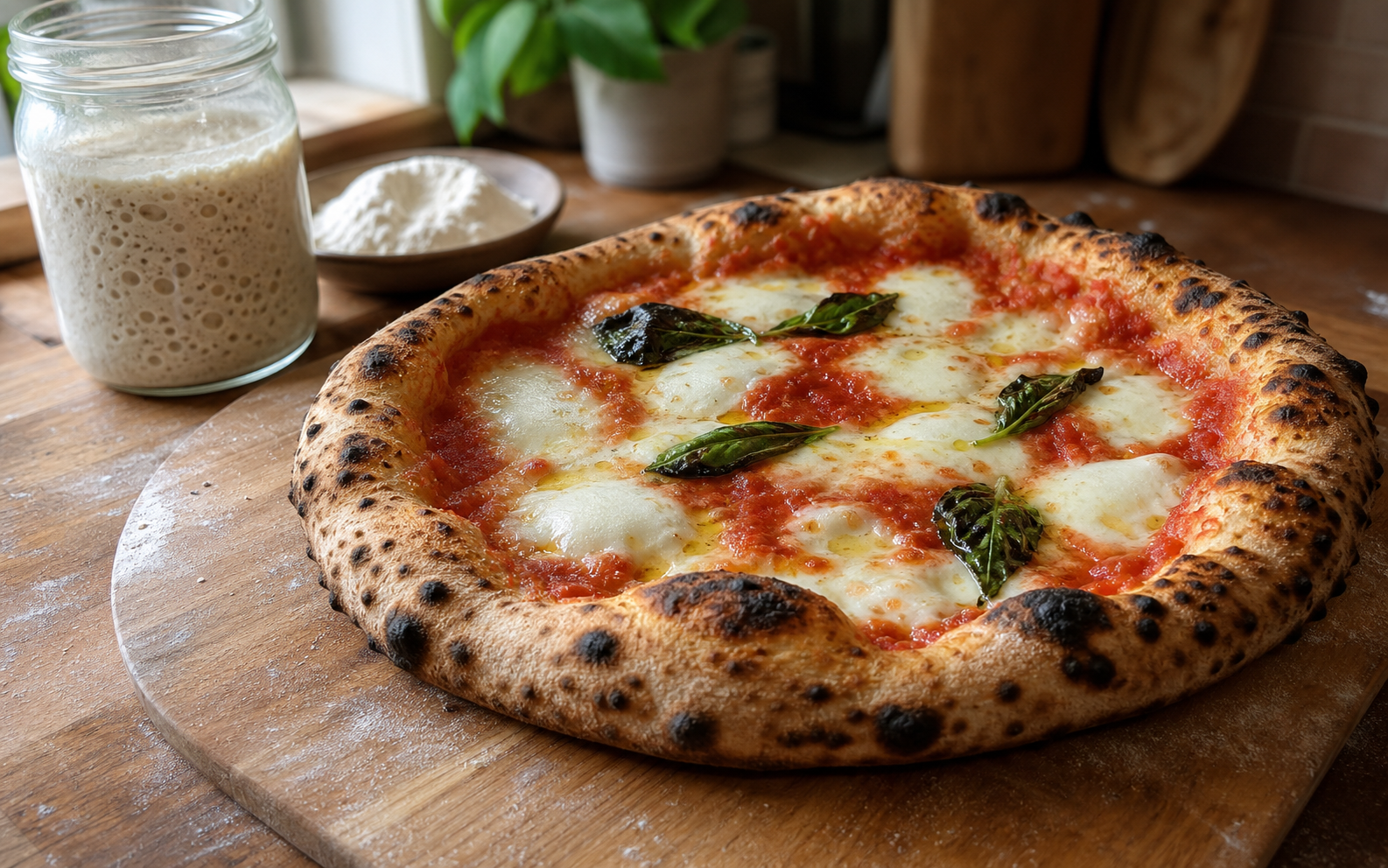
The journey started with a small amount of discard from my wife's sourdough starter. She had kept it alive for four years and primarily used einkorn flour, which gave it a flavor and character of its own.
I wanted to take that living culture in a different direction. My goal was to build a flavor profile around Italian-style 00 flour, or a flour with similar pizza-making characteristics, while learning how to create the light, inflated cornicione I loved in great Neapolitan pizza.
That small bit of discard became the foundation of an entirely new experiment. I began feeding it for the dough I wanted to make, paying attention to its strength, aroma, timing, and response to a different flour.
Learning from generous teachers online
I spent hours watching pizza makers on YouTube, especially Vito Iacopelli. I first learned about his work through channels I already followed, including Guga Foods and Sous Vide Everything.
Vito's enthusiasm and explanations helped me see that pizza dough is not simply a list of ingredients. Temperature, time, flour strength, hydration, fermentation, handling, and oven heat all affect the final result. Watching a skilled pizzaiolo make it look effortless gave me both a goal and a false sense of confidence about my first attempt.
The first pizzas were complete disasters
I started recording YouTube videos as I learned. The first couple of pizzas were disasters. Dough stuck where it should not stick. Shapes became accidental. Timing was off. The crust I imagined and the crust that came out of the oven were not close relatives.
Those failures were frustrating, but they were useful. Every disappointing pizza gave me another question to investigate: Was the dough under-fermented? Did I weaken it during shaping? Was the hydration too ambitious for my flour or experience? Had I allowed enough time for the dough to warm before stretching? Was my home oven simply unable to deliver the heat fast enough?
A failed pizza is still dinner, but it can also be a very honest teacher.
Over time, the dough became easier to handle. The crust began to rise instead of remaining dense. The flavor became more layered. I learned to make smaller adjustments and observe the result instead of changing everything at once.
My long-fermentation approach
My process borrows the concept of a poolish, but I use it in my own evolving way with the sourdough culture. I build the dough through multiple stages, creating what I think of as a double or sometimes triple fermentation.
The purpose is to develop strength and flavor gradually. I normally aim for about 72 hours of total fermentation, with 48 hours as my minimum target. The exact timing changes with temperature, starter activity, flour, hydration, and the dough itself, so the clock cannot be the only guide.
I have found that this slower approach produces dough that is stronger, more flavorful, and more enjoyable for me to eat. Some people report that long-fermented dough feels easier for them to digest, but fermentation is not a medical guarantee and individual experiences vary.
Building every layer at home
The dough became the obsession, but I did not want to stop there. I began making my own pizza sauce so I could control its brightness, texture, salt, and balance. I also started making mozzarella, adding another variable and another skill to improve.
Making the major components myself has helped me understand how simple ingredients depend on one another. A delicate crust can be buried under too much sauce. Wet cheese can slow the bake in a home oven. A great tomato does not need to be hidden behind a long list of seasonings. When the pizza has only a few ingredients, each one has to contribute without taking over.
Restaurant-quality pizza from a home oven
The last few pizzas have earned the compliment I had been chasing: people told me they were restaurant quality. That means a great deal because every one of them was made in a standard home oven, without the extreme heat that gives Neapolitan pizza its fast bake and characteristic puff.
A home oven imposes limits. The bake takes longer, so the challenge is getting color and lift without drying the crust or overcooking the toppings. I am still experimenting with preheating, baking surfaces, placement, and finishing techniques to get the best result from the equipment I have.
Those limitations have also made the progress more meaningful. If the dough can create an airy, flavorful crust in a home oven, I am excited to see what it may become when I can invest in a dedicated pizza oven.
The dream is bigger than the recipe
I am not ready to call the recipe perfect. In fact, I hope I never lose the desire to improve it. I am still adjusting fermentation, flour blends, hydration, shaping, sauce, cheese, and baking technique. I am also continuing to document the process on video, including the mistakes, because the progress means more when the rough beginning is still visible.
The next practical step is saving for better equipment. A true pizza oven would be a major improvement over a home oven and would move the experiment closer to the style I am trying to create. After that comes the much larger investment required to turn a home pursuit into a real food business.
For now, I am building the recipe before I build the business. Every batch is another test. Every pizza teaches me something. And every time someone takes a bite and says it tastes like it came from a restaurant, the dream feels a little less distant.
What this journey has taught me
- Start with what you have. My journey began with a little discard and a home oven.
- Learn from people who share their craft. Hours of generous instruction online gave me a foundation for my own experiments.
- Record the failures. The early videos remind me how much technique can improve through repetition.
- Change one variable at a time. Dough becomes easier to understand when every batch is not a completely new formula.
- Let the product earn the dream. I want the recipe and process to be worthy before investing in a business around them.
This is still the beginning. The final recipe, the right oven, and the business plan are ahead of me. But the pizza is getting closer, the crust is rising higher, and the idea that started on work trips across the country is now taking shape in my own Indiana kitchen.